Excerpt
INTRODUCTION
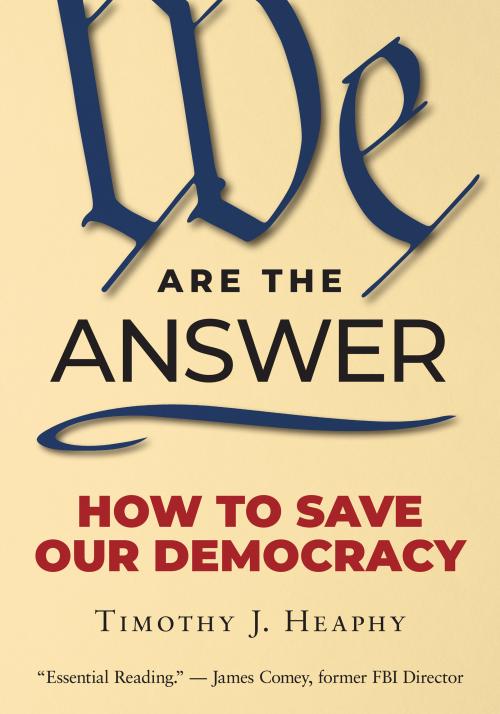
Over the course of my career, I’ve learned that lawyers often become accidental specialists. The matters on which they work, the cases they try, and the endeavors they pursue inform their subsequent choices and opportunities. I did not set out to specialize in political violence. Through a series of unexpected challenges in the communities I call home, I have been fortunate enough to be part of the response, the understanding, and the healing in the wake of two of the most searing episodes of political violence in our nation’s history. I am, in many ways, a reluctant expert in political violence and all it reveals about America.
I led a team that conducted an independent review of the racist riot that occurred in my hometown of Charlottesville, Virginia, on August 12, 2017. Back then, I was a former United States attorney hired by the city government to conduct an “after-action” report detailing how the city prepared for and managed the Unite the Right (UTR) rally that became a forum in which fascist white nationalists clashed with anti-racist counter-protesters in the small city in which I live. Our team issued a lengthy report that contained harsh criticism of law enforcement, city and state officials, and other decision makers, calling out their failure to protect either public safety or free speech in Charlottesville. The Heaphy Report has become the definitive account of that tragic day.
My experience in Charlottesville ultimately led to my role as chief investigative counsel for the January 6 committee in the House of Representatives. Over the course of my work on these investigations, I have spent considerable time looking closely at these two seminal events. Along with a team of experts, I spent untold hours reviewing footage and reading emails, text messages, and other documents generated before, during, and after by people who both perpetrated and tried to prevent them.
Charlottesville and January 6 are inextricably linked in the consciousness of Americans. As horrific as those days were, studying, considering, and talking about them can point us toward a way forward out of the darkness that currently threatens to kill American democracy as we know it.
One central connection between Charlottesville and January 6 is that both events were planned online, in plain view, on social media. The organizers of the Unite the Right rally encouraged like-minded people to attend by actively promoting the event on Facebook, Twitter, Parler, Reddit, and other social media sites. A little over three years later, the Proud Boys, Oath Keepers, and others who sincerely but misguidedly believed the 2020 presidential election had been stolen used these same platforms to draw attention to the January 6 certification proceeding at the Capitol.
Despite the fact that both the Charlottesville rally and the January 6 attack on the Capitol were planned on open-source channels, law enforcement was woefully unprepared for them. Agencies failed to share information across jurisdictional lines or aggregate information. Implicit racial bias affected preparation for each event, as those agencies failed to appreciate the danger presented by angry white men.
Since the events of January 6, the job of law enforcement has been made more difficult as accountability has been stripped away. In protecting us from future spasms of political violence, law enforcement must work in a new reality, a world in which the president of the United States has pardoned nearly 1,600 people involved in a violent, lethal attack on the US Capitol which aimed to nullify the results of a free and fair election. If investigating, prosecuting, and punishing perpetrators is deterrence, then it logically follows that pardoning acts of political violence and lawlessness will encourage more of the same.
The most salient commonality between Charlottesville and January 6 was how each event metastasized from a focus on one core issue to become a broader forum for the expression of anger at institutions. Charlottesville started as a protest about the removal of Civil War statues in public spaces. It became a protest at which a constellation of groups came together to express anger about how our increasingly diverse culture threatened their historic privilege. The unifying principle on January 6 was belief in the “Big Lie” that the 2020 election had been stolen from President Trump. Many participants in the attack on the Capitol were, however, drawn there by a broader cynicism about government and disbelief in what they routinely hear from politicians, the media, and educational institutions. As in Charlottesville, some January 6 rioters believed that the national government is run by self-interested elites determined to replace them with immigrants. Others were motivated by a belief that public health mandates during the pandemic were baseless and infringed their liberty. These groups came together under a common banner of resistance to a system that they regard as oppressive and believe does not work for them.
The core division in this country revealed by Charlottesville and January 6 prompts both anger and apathy among Americans. While some people express their anger by taking part in mass demonstration events, others simply turn away. Many people in this country don’t vote, pay attention to current events, or actively participate in their communities. Withdrawal is as dangerous as anger. A disengaged citizenry is a more insidious threat to democracy, and ultimately more destructive, than a large crowd of angry rioters.
Identifying effective solutions to this division in America will require grassroots involvement by a much wider spectrum of voices than those that currently participate in these discussions. Our future success will require everyone to care and contribute. The best way to restore faith in government is to make it more responsive to the core needs of the people governed. That requires participation and engagement, not apathy and withdrawal. When people of good faith fail to participate, extreme perspectives are amplified and get outsized attention. We need to run toward, not away from, the problems facing this country, those revealed by these episodes of political violence and many others.
“Truth and reconciliation are the only hope for nations that are bitterly divided,” Nelson Mandela wrote in 1999.[i] I keep coming back to his words as I think through how we got here, and how to move forward. My hope is that this book helps us understand the meaning of Charlottesville and January 6 so we can learn from them and use those lessons to guide us forward as we, the people, strive to restore civility and defend American democracy, lest we lose it forever.
[i] Nelson Mandela, “We should forgive but not forget,” Guardian, July 2, 1999, reprinted from Civilization Magazine, https://www.theguardian.com/world/1999/jul/03/guardianreview.books7.